

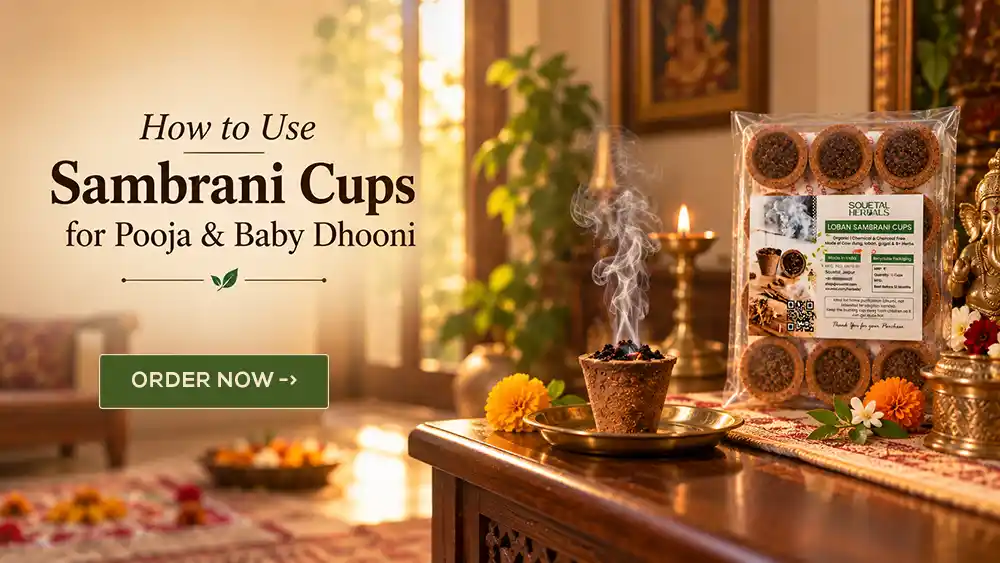
Every evening, in lakhs of Indian homes, someone walks from room to room with a plate of dhooni – filling the house with smoke and fragrance before the lamps are lit. It’s one of those rituals nobody really “starts” doing; it’s just always been there, passed down from grandmothers who did it, and their grandmothers before them.
The tradition itself hasn’t changed. What’s changed is how much effort it takes to keep it going.
If you’ve ever tried to do this the traditional way, you know the drill – sourcing loban, guggal, and half a dozen herbs separately, mixing them by guesswork, and hoping this batch burns as evenly as the last one. Some days it’s fragrant, some days it’s mostly smoke and frustration. Which is exactly why sambrani cups (also called sambrani dhoop cups, loban sambrani cups, or havan cups) have quietly become the way most urban Indian households do their daily dhooni now – same ritual, same intent, none of the tamjham.
This guide covers everything you need to know: what sambrani cups actually are, how to use them safely for everyday pooja, how families traditionally use them for a newborn baby’s dhooni, and what to look for before you buy sambrani cups online.
What Are Sambrani Cups?
Sambrani (also spelled sambrani or referred to as loban in Hindi) is a fragrant resin – traditionally benzoin or a benzoin-based blend (लोबान / लोहबान) – that has been burned in Indian homes for generations to fill living spaces with a thick, sweet, purifying smoke. A sambrani cup is simply that resin blend pressed into a small, self-contained cup or disc, so you can light it directly instead of burning loose herbs on charcoal.
You’ll hear these called a few different names depending on the region and the household:
- Sambrani dhoop cups
- Loban sambrani cups (लोबान संब्रानी कप)
- Havan cups
- Dhooni cups
They’re all pointing to the same idea – a ready-to-light cup that recreates the evening dhoop-dhooni ritual without the prep work. Click here to Try Our Loban Sambrani cups.
Why Indian Households Still Swear By Sambrani Dhoop Cups
Ask anyone who does this daily, and the reasons are rarely just about fragrance:
- It’s part of the daily rhythm. For many families, lighting a sambrani cup before the evening aarti isn’t optional – it’s how the day is closed out.
- The smoke is meant to clear the air, literally and otherwise. Traditionally, evening dhooni is believed to drive out staleness and negativity from the home – you’ll notice most households do it right at dusk, when the day’s energy is thought to be at its lowest.
- The fragrance lingers, and people notice. This is the one every household with a strong loban cup will tell you about – the smell is strong enough that neighbours genuinely ask, “aaj ghar mein kaunsi pooja thi?” It’s a small thing, but it matters to people who take their home’s atmosphere seriously.
- It naturally works as a mosquito and insect deterrent in the evening, which is a quiet bonus most people only mention when asked directly.
None of this replaces medical or pest-control advice – think of it as what it’s always been: a fragrance and purification ritual, not a treatment for anything.
How to Use Sambrani Cups for Daily Pooja (Step-by-Step)
Using a sambrani cup (संब्रानी कप) is genuinely simple, but doing it safely matters more than doing it fast. Here’s the right way:
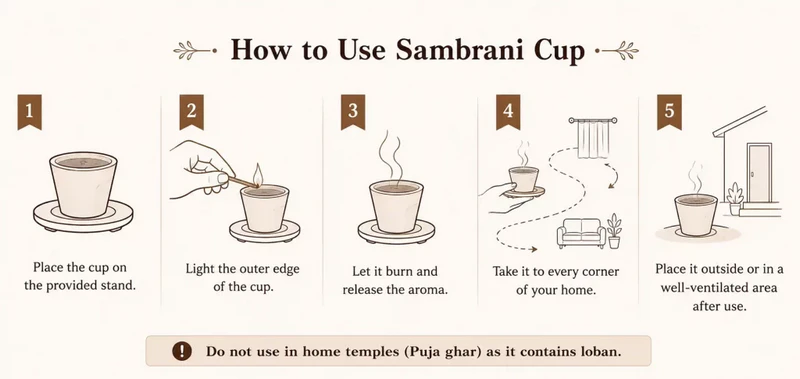
- Choose a heat-resistant base. Place the cup on a steel plate, stone urli, or a dedicated stand – never directly on a wooden surface, carpet, or cloth.
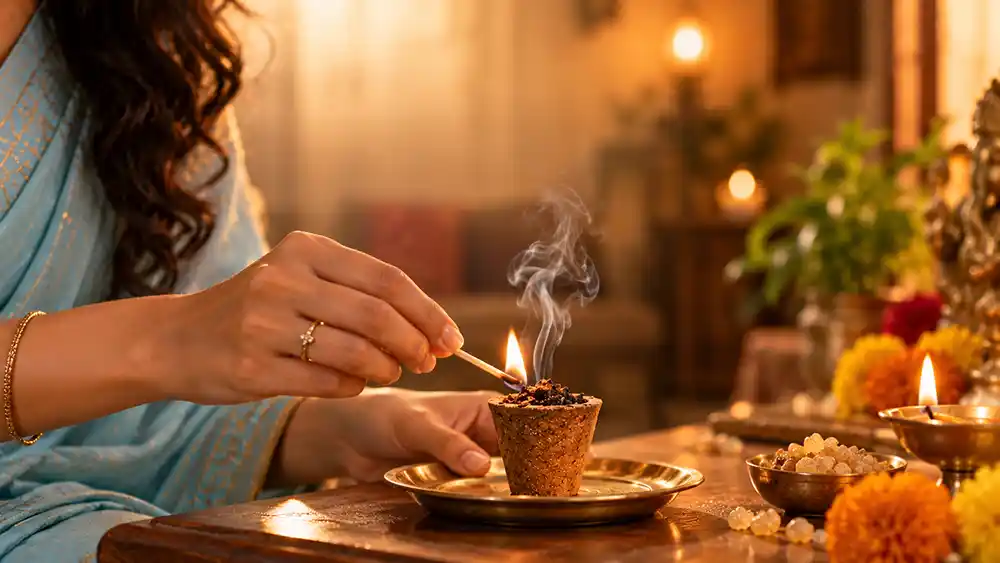
- Light one edge of the cup, not the centre. Hold the flame there for a few seconds until it visibly catches and starts smouldering on its own.
- Let it settle for 10–15 seconds before moving it. Once it’s burning steadily, it won’t need a flame again – it’ll smoulder on its own.
- Walk it through the house the way your family traditionally does dhooni – living room, entrance, kitchen – letting the smoke fill each space for a few seconds.
- Keep windows or a door slightly open. A closed, airtight room fills with smoke fast and gets uncomfortable – dhooni is meant to be aromatic, not overwhelming.
- Place it somewhere stable to finish burning, away from curtains, prayer cloth, and anything flammable, and never leave it unattended near children or pets.
One thing worth knowing: loban-based sambrani cups (लोबान संब्रानी कप) produce a thicker, stronger smoke than regular agarbatti or dhoop sticks. Most families use them for the ghar ki dhooni – filling the open rooms of the house – rather than lighting them inside a small, closed mandir unit or right next to idols and diyas, simply because the smoke is dense enough to need open airflow to be enjoyable rather than overpowering.
How to Use Sambrani Cups for Newborn Baby Dhooni
This is one of the oldest continuing traditions in Indian households – giving a newborn a gentle dhoop or dhuni in the days and weeks after birth, often as part of welcoming the baby home. It’s typically done by an elder in the family, and the belief behind it is one of warmth, protection, and blessing for the child.
Because a newborn is involved, this is a place where tradition and safety need to go hand in hand. If your family follows this custom, here’s how it’s usually – and safely – done:
- Light the sambrani cup in a separate corner of the room, well away from the baby, not right beside the crib or in the parent’s hands while holding the baby.
- Let the smoke drift through the room rather than directly over the baby’s face. The idea is a lightly fragranced room, not smoke exposure.
- Keep the session brief – a minute or two of the room being scented is enough; there’s no need to let it burn the full duration near the baby.
- Always keep a window or door open so the room has fresh air moving through, and never do this in a fully sealed room.
- Never let the cup, ash, or any part of it come near the baby, the crib, or bedding.
- If your baby was born prematurely, or has any breathing sensitivity, check with your paediatrician first – every baby is different, and a doctor who knows your child’s health is a better judge than any general guide.
This tradition has been passed down for a reason families trust deeply – the goal of these steps is simply to carry it forward the way most grandmothers actually did it: mindfully, with the baby’s comfort always coming first.
Why Charcoal-Free Sambrani Cups Make a Real Difference
Not all sambrani cups are made the same way, and this is worth knowing before you buy. Many mass-market versions use a charcoal base mixed with synthetic fragrance oil to bulk up the cup cheaply – which means more black soot, a sharper “burning” smell, and a heavier smoke that can leave a film on walls and furniture over time.
Charcoal-free sambrani cups, made instead from a natural resin and herb base, tend to burn cleaner – less soot, a rounder and more natural fragrance, and smoke that dissipates rather than lingering as a haze. If you’re using these cups often, especially around a newborn’s room or in a smaller home, this difference is genuinely noticeable within the first few uses.
Sambrani Cups vs Dhoop Batti vs Agarbatti – What’s the Difference?
A quick way to think about it:
- Agarbatti (incense sticks) burn slowly over a long stick and give a light, continuous fragrance – good for a subtle, all-day scent.
- Dhoop batti is a solid stick or cone of packed herbs, burned for a stronger, more traditional fragrance over a shorter time. Try our Premium Dhoop Batti here.
- Sambrani cups / loban sambrani cups give the thickest, most immersive smoke of the three – built specifically for the “fill the whole house” style of dhooni, not for a light, ambient scent.
If your household ritual is about walking room to room and really scenting the space, sambrani cups are the closest thing to how it was traditionally done.
What to Check Before You Buy Sambrani Cups Online
With so many options now available, a few things are worth checking before you order:
- Charcoal-free, resin-based composition – check the listing or ask the seller directly.
- Consistent burn time – a good cup burns evenly for 15–20+ minutes without needing to be relit.
- No harsh synthetic smell when unlit – natural sambrani has a mellow scent even in the cup; a sharp chemical smell before burning is usually a sign of synthetic fragrance oil.
- Packaging that protects the fragrance – resin-based cups lose potency if left exposed to air for long periods.
Some traditions don’t need reinventing – they just need to be made a little easier to keep. That’s really all a good sambrani cup does: the same dhooni, the same fragrance filling the house, minus the hunting for herbs and guessing at quality every single time.